
Avetik Isahakyan's poetry combines the intimacy of song with philosophical questioning. Love and separation lead into reflections on injustice, freedom and the place of the individual in the world.
Avetik Isahakyan
Person
Type

Life and context
Born in Alexandropol in 1875, he studied at the Gevorgian Seminary and attended lectures in Leipzig. Long periods abroad connected his life with several European countries. He returned permanently to Armenia in 1936 and died in Yerevan in 1957.
Major works
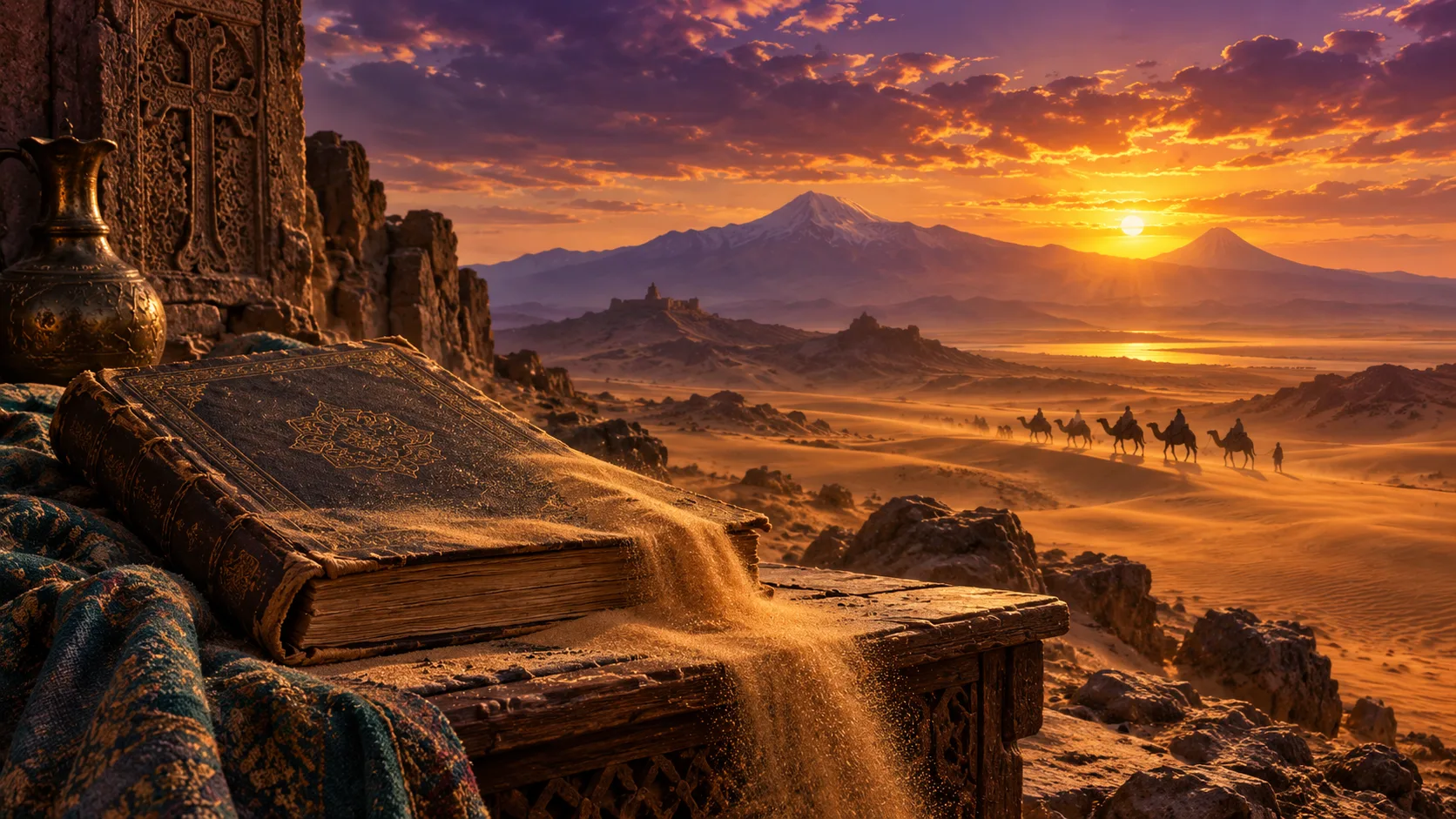
Songs and Wounds brings personal emotion close to the rhythms of popular lyric. Abu-Lala Mahari uses the journey of a poet leaving society as a frame for protest and spiritual searching. Its desert landscape becomes an imaginative space in which inherited values are questioned.
His prose also favours the concentrated form: legend, parable and brief narrative allow a single encounter or image to carry a larger thought.
Literary legacy
Isahakyan's distinctive strength is the movement between the familiar and the universal. The voice may begin with a personal wound, yet it addresses loneliness and the desire for dignity across cultures. His house-museum in Yerevan preserves manuscripts, books and the atmosphere of his later life.
The cover and section images are AI-generated symbolic illustrations. The gallery portrait comes from a historical source.
Reading the works closely
In Isahakyan's poetry, love, separation and exile often grow into questions about the whole of life. A songlike voice can carry complex reflection. In Abu-Lala Mahari, the journey into the desert is also an inward movement away from hypocrisy and injustice toward an imagined freedom. Caravan, distance and sunlight help give this movement visible form.
Do not treat every statement by the speaker as the author's final belief. The poem's Mahari is a literary creation, not a documentary biography of the historical Arab poet. Likewise, Lilith uses myth to explore desire and the gap between an ideal and reality; its narrative is not a historical or religious factual claim.
Read, reflect and investigate
Mark recurring images in a short poem and explain the feelings they create. For Abu-Lala Mahari, compare the world the speaker rejects with the world he seeks. Can departure alone create freedom? Support your own answer with the text rather than simply agreeing with the character.
This article was created using artificial intelligence.
For suggestions regarding collaboration, content, or the further development of this page, please contact the Armenian Treasures Foundation.
Photography Archive
Gallery
Explore more entries
Back to Writers