The empire of Tigranes and the road to war
A turning point, not the end of Armenia
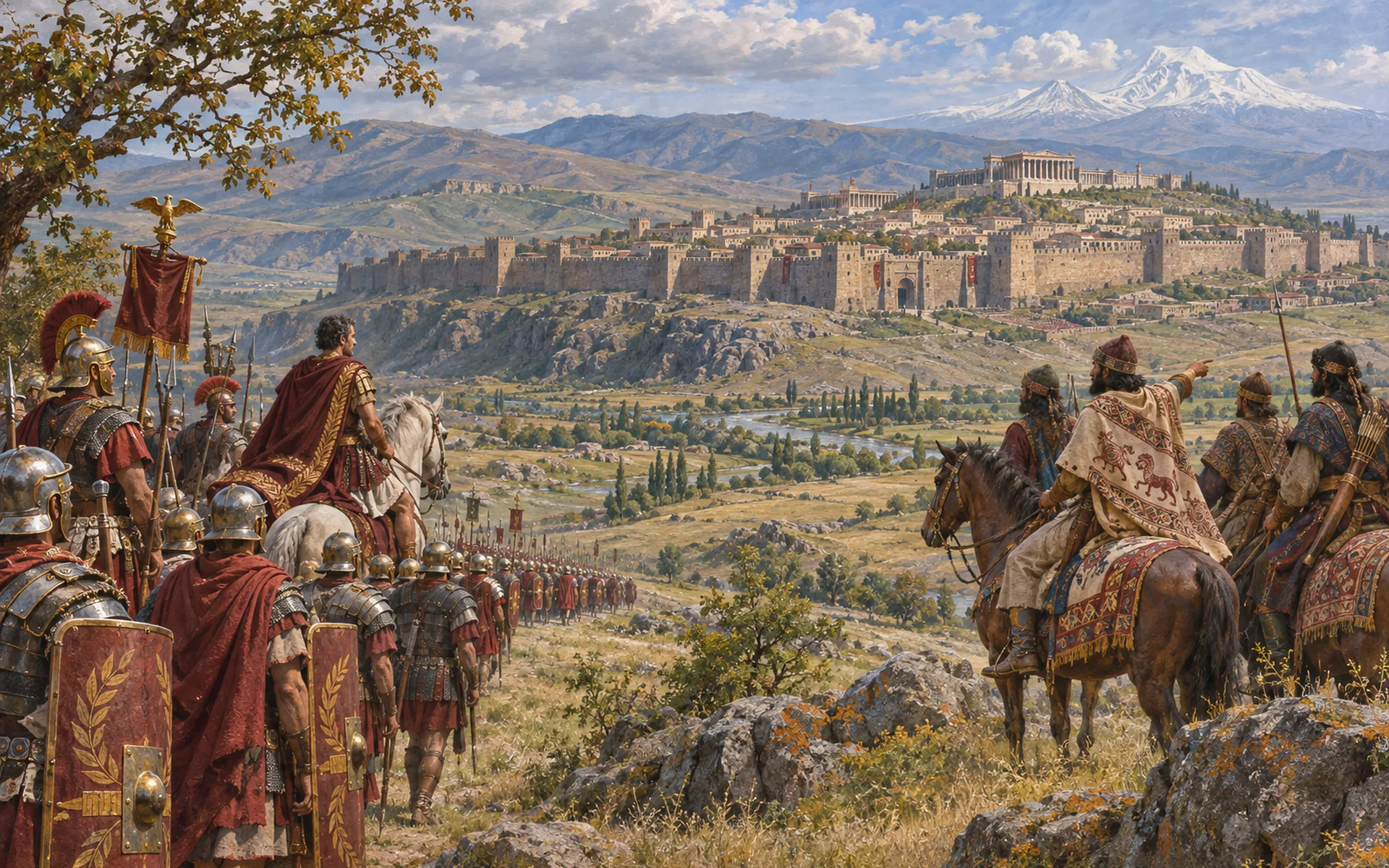
In 69 BCE, the army of Tigranes II of Armenia met the forces of the Roman commander Lucius Licinius Lucullus near Tigranocerta. The Armenian king lost the battle, and his newly established royal city subsequently fell. These were serious blows to an empire that had expanded rapidly across the Near East. They were not, however, the disappearance of Armenia or the end of Tigranes’ reign. The king continued to resist, and the political settlement with Rome came several years later.
This distinction is the starting point for understanding the event. A battle is a particular encounter; a campaign includes marches, sieges, supplies, and several engagements; a war can continue after a spectacular victory. A kingdom can surrender conquered territories while preserving its central institutions. Reading these different scales together makes Tigranocerta a lesson in historical reasoning rather than merely a story about a victorious general and a defeated king.
Armenia between three great powers
Tigranes the Great ruled from 95 to 55 BCE. During his reign, Armenia became a major regional power, extending its authority over territories beyond the Armenian Highlands, including parts of Mesopotamia and Syria. This expansion took place within a changing political landscape. The Seleucid monarchy was weakening, Parthia remained a powerful eastern neighbor, and the Roman Republic was extending its influence through Anatolia.
Ancient empires did not necessarily resemble countries with a single administrative system and stable borders. Some regions were governed directly; others retained local rulers who owed allegiance, tribute, or military assistance to a stronger monarch. A map colored in one shade can therefore conceal very different relationships. Tigranes’ power depended not only on soldiers but also on cooperation, transport routes, royal resources, and the ability to hold together communities with different languages and political traditions. Rapid territorial growth increased prestige while also creating new responsibilities and exposed frontiers.
Mithridates and the road to conflict
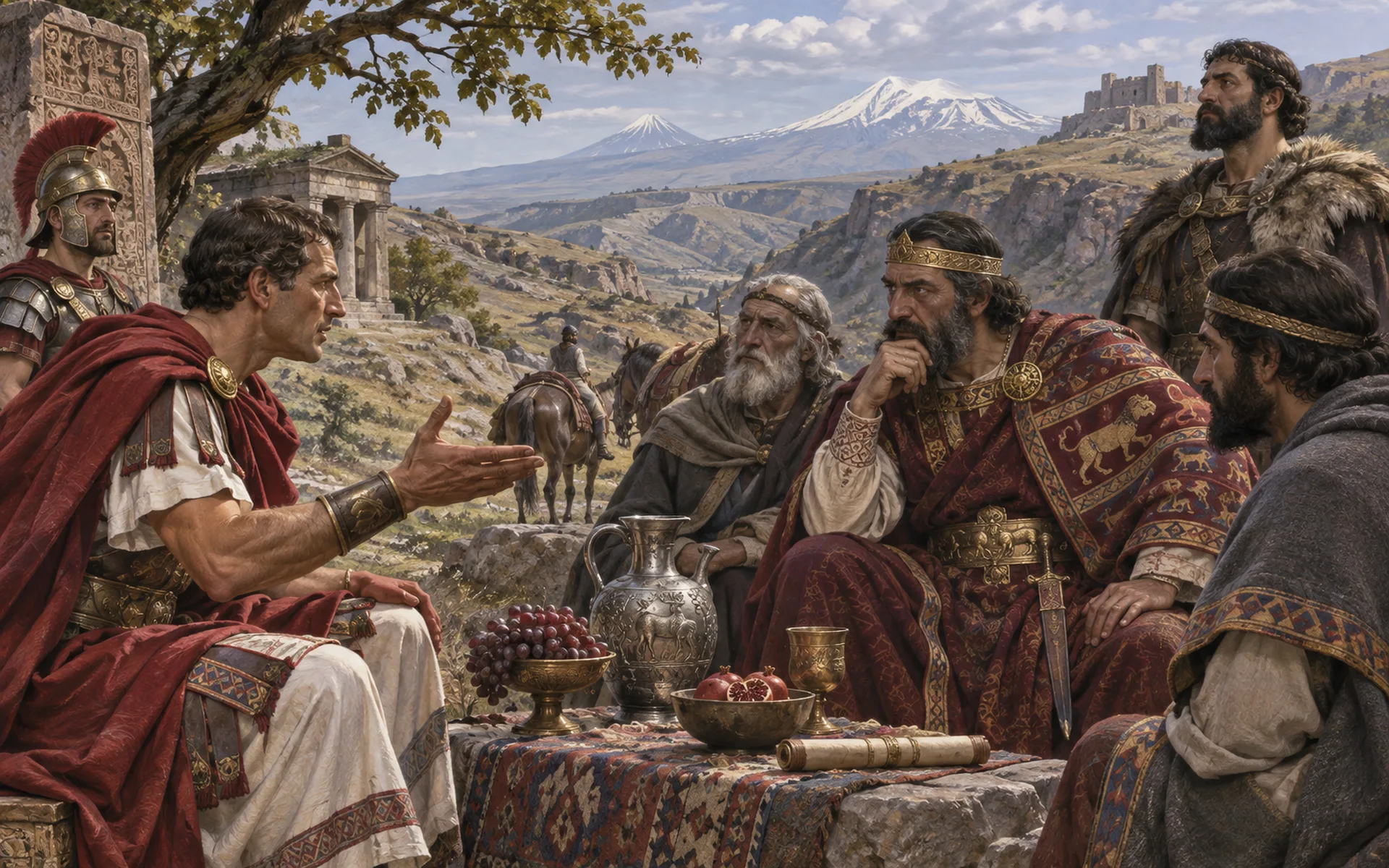
An important figure in the conflict was Mithridates VI, king of Pontus, a kingdom on the southern side of the Black Sea. He was Tigranes’ father-in-law and a long-standing opponent of Rome. After defeats in his struggle with Lucullus, Mithridates sought refuge in Armenian territory. Rome demanded his surrender. Tigranes refused, and the dispute became part of the justification for Lucullus’ invasion.
It would be misleading to reduce the entire war to a family relationship. Granting protection to a defeated ruler involved diplomacy, royal dignity, and the question of whether another state could dictate a king’s decisions. Rome also had wider strategic interests in the eastern Mediterranean and Anatolia. Armenia’s earlier expansion had brought it into a region where Roman influence was increasing. Kinship helps explain the alliance, but imperial competition explains why the consequences reached far beyond two royal households. Students should distinguish an immediate trigger from the deeper conditions that made conflict possible.
Why the new capital mattered
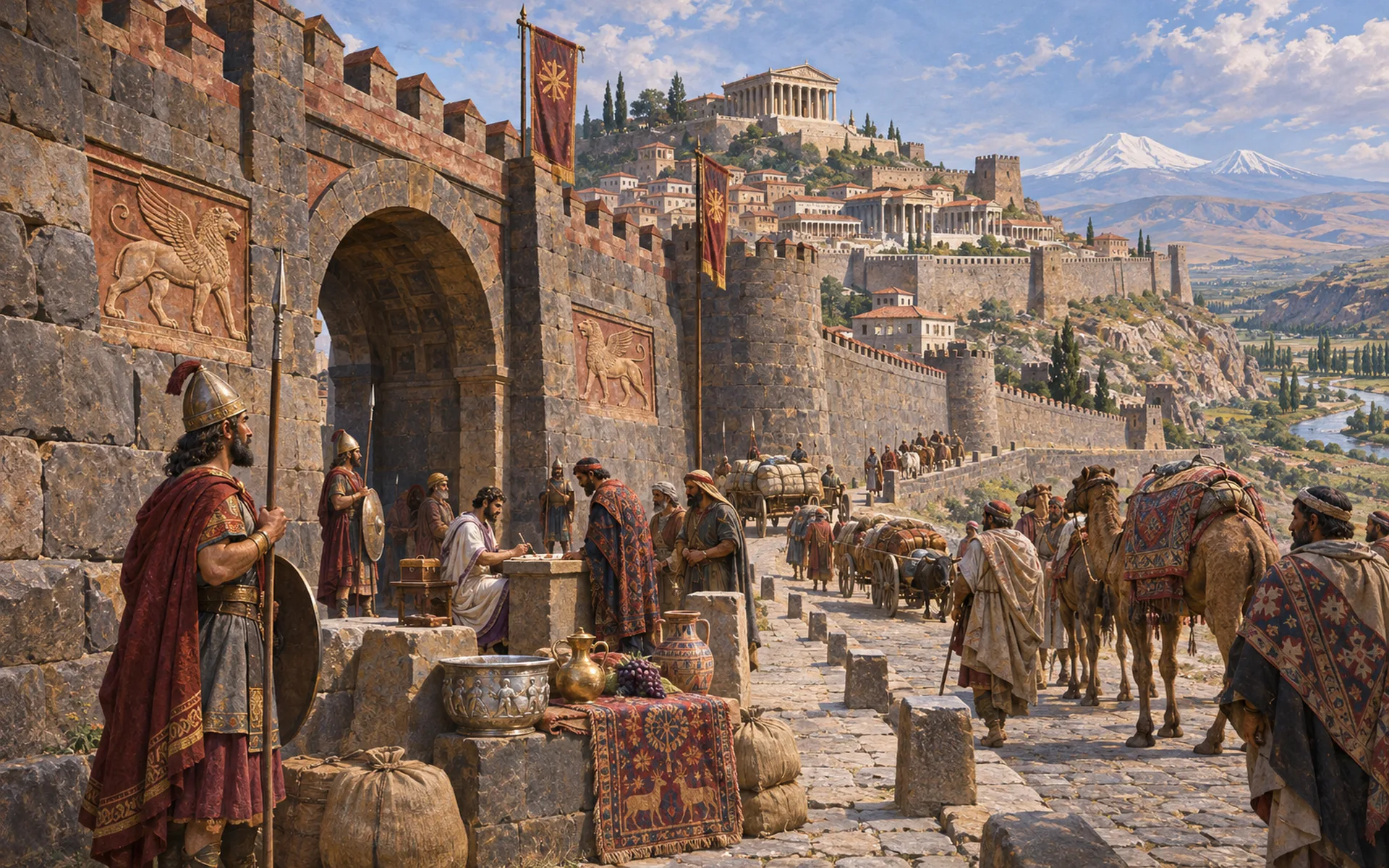
Tigranocerta was a statement of royal ambition. Ancient writers describe fortifications, a palace, wealth, and a theater. Its name connected the settlement directly to its founder, Tigranes. The city helped express a monarchy participating in the wider Hellenistic world, where royal foundations, public buildings, and prestigious urban centers were important instruments of power.
Its population also reveals a difficult side of ancient state building. People were transferred there from other communities, including conquered cities. These movements were not simply voluntary migration. A splendid capital could represent opportunity for some inhabitants and loss of home for others. This helps explain why the loyalties of residents and soldiers inside the walls cannot be assumed to have been uniform.
The precise identification of the battle’s Tigranocerta remains debated. There were several settlements bearing versions of Tigranes’ name. A modern photograph of another Tigranakert should never be presented as the proven battlefield. Uncertainty about location does not erase the event, but it limits the precision of maps and visual reconstructions.