Upcoming Projects/Tavush/Digitizing Tavush’s Cultural Heritage
Digital Heritage · TavushDigitizing Tavush’s Cultural Heritage
From Haghartsin and Goshavank to Makaravank: digitally documenting Tavush’s heritage and sharing its stories around the world.
A bend in one of Tavush’s forest roads may reveal a church courtyard. From a distance, you see the dome; closer up, a pattern carved into stone. When you learn who studied and worked here, a beautiful view becomes part of your own story.
For one person, that road recalls a childhood trip with family. For another, it is a first encounter with their ancestors’ homeland. Both want to take something away that will last longer than the impressions of a journey.
That connection deepens when we can learn about what we have seen and tell someone else. A monument’s name, its structure, or the meaning of a carving becomes knowledge we can share with a child, a friend, or a classroom.
Armenian Treasures’ Tavush digitization project plans to continue that encounter online through carefully documented, accessible materials.
Haghartsin, Goshavank, and Makaravank: Places Worth Knowing
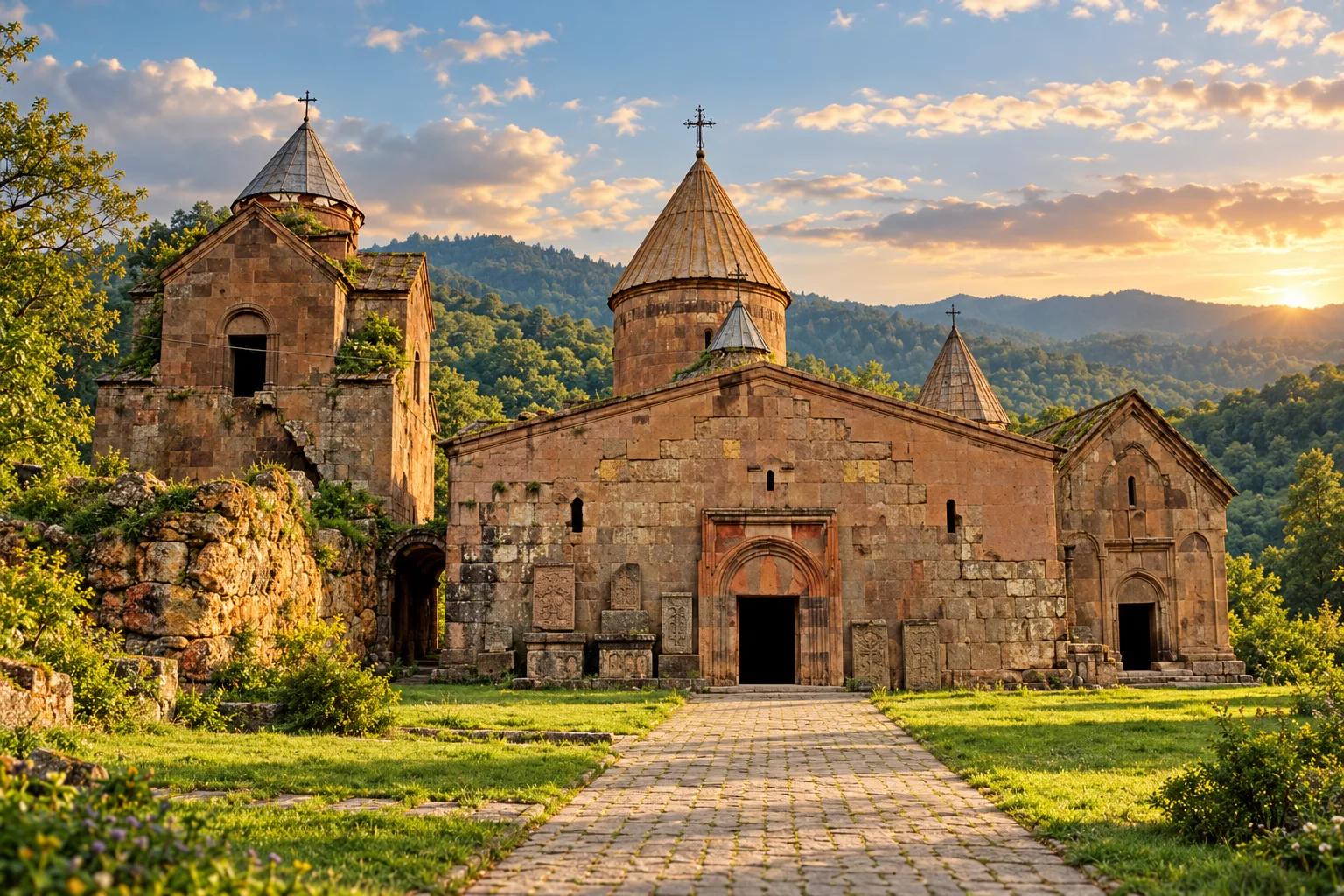
Haghartsin Monastery stands in the forests of Dilijan National Park. Its churches and refectory offer a chance to explore different approaches to medieval Armenian architecture and to see how a built environment relates to its natural surroundings.
Goshavank is associated with Mkhitar Gosh and his educational work. Its intricately carved khachkars testify to remarkable skill in stonework. The decorative carvings at Makaravank likewise invite us to pause over the details and examine the work of their makers.
Alongside these well-known complexes, Tavush has smaller sanctuaries and places cherished by local communities. To understand their importance, we also need to know the surrounding settlement and the people for whom these places hold memories.
We want the next generation to receive Tavush’s heritage with its names, its details, and a history they can understand.
What Digital Documentation Will Offer
The project aims to document the structures, visible condition, and architectural features of selected monuments in detail. At suitable sites, 3D and 360° materials will help people understand the buildings’ forms and spatial relationships.
Visible inscriptions, ornamental carvings, and stonework will receive particular attention. Historical information will be prepared from researched sources, and traditions will be clearly presented as traditions.
The goal is to create resources people can return to at their own pace. One person may study a khachkar’s ornament, another the arrangement of a complex, and a third may use the material to prepare for a future visit.
Tavush at Home, at School, and in the Diaspora
Imagine a family opening a monument’s page together, with a parent saying, “I want you to know this place, too.” A child can explore the site, read in a language they understand, and continue the family’s story through their own questions.
For a schoolchild in Tavush, the same page can connect a textbook with their own community. A teacher can use it to discuss architecture, manuscript culture, and medieval education. Researchers will find value in the documented details and their descriptions.
Multilingual materials will also introduce these places to Armenians living abroad and to interested people of other backgrounds. Tavush can become familiar through specific sites, their histories, and the work people created there.
Planned Project Activities
The project plans to:
• select and document priority historical and cultural sites in Tavush;
• carry out 3D scanning and 360° photography at suitable sites;
• process the collected data and prepare digital models and virtual tours;
• research historical sources and prepare multilingual materials;
• publish the results on the Armenian Treasures platform for online exploration.
The final list of sites and the scope of work will be determined by documentation needs, work already completed, and available funding.
Preliminary Funding Goal: $69,225
The funds raised are intended to support fieldwork, digital imaging, data processing, and the online presentation of the completed materials.
Your support could become the detailed documentation of a site, a useful teaching resource, or a family’s first shared encounter with its heritage.
Behind every monument entrusted to us are people’s time, knowledge, and work. Today, our contribution can be the care we give to that work: studying, recording, and sharing what we have the opportunity to know.
Help the next generation’s connection with Tavush begin with curiosity and grow through reliable knowledge.
Become a guardian of Tavush’s heritage.
Lighting and colours enhanced with AI. Photographs: Haghartsin Monastery — Aleksey Chalabyan a.k.a. Xelgen · Goshavank Monastery — Thomas Wozniak · Makaravank Monastery — Soghomon Matevosyan · CC BY-SA 4.0


